Most people can tell you the Civil Rights Act of 1964 “ended segregation,” but ask what it actually says, which parts of daily life it covers, or why an EEOC discrimination complaint at work traces back to it, and the details get fuzzy fast.
That gap is worth closing, because this law isn’t just a historical milestone — it’s the legal foundation behind workplace discrimination protections, public accommodation rules, and school desegregation policy that still apply today. This guide breaks down what the Civil Rights Act of 1964 actually did, how it survived one of the longest filibusters in Senate history, and which parts of it you’re most likely to encounter in real life.
What Is the Civil Rights Act of 1964?
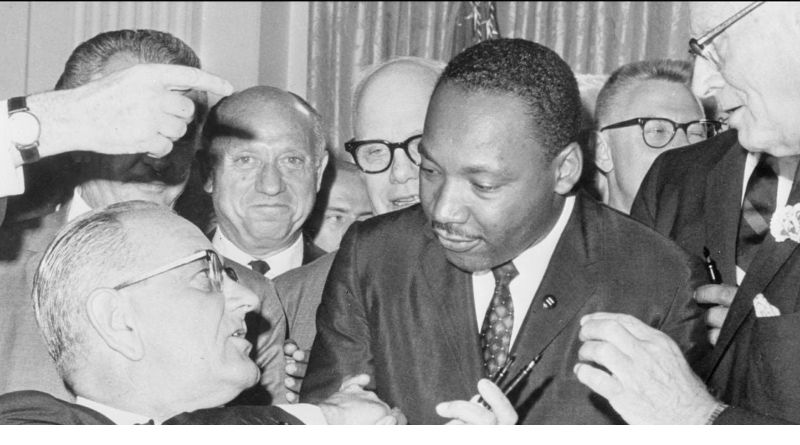
The Civil Rights Act of 1964 is a landmark federal law that outlawed discrimination on the basis of race, color, religion, sex, and national origin. Signed by President Lyndon B. Johnson on July 2, 1964, it banned discrimination in public accommodations, public facilities, federally funded programs, and employment, and it created the Equal Employment Opportunity Commission (EEOC) to enforce workplace protections.
It’s organized into eleven sections, called “titles,” each addressing a different area of American life where discrimination had been legal, widespread, or both.
How the Civil Rights Act of 1964 Came Together
The bill’s origins trace back to President John F. Kennedy, who proposed sweeping civil rights legislation in June 1963 in response to escalating civil rights protests and violent resistance to desegregation across the South.
Kennedy was assassinated in November 1963 before the bill passed, and it fell to his successor, Lyndon B. Johnson, to push it through Congress. Johnson framed passing the bill as a tribute to Kennedy’s legacy, using that framing to build momentum in a Congress where Southern lawmakers were determined to block it.
That resistance came to a head in the Senate, where opponents mounted a filibuster lasting 54 days — one of the longest in U.S. Senate history. It was ultimately broken through a successful cloture vote, a procedural mechanism that cuts off debate, allowing the bill to finally reach a floor vote and pass.
What Each Title of the Civil Rights Act of 1964 Actually Covers
The law is best understood title by title, since each one targets a distinct area of discrimination.
Title I: Voting Rights
Barred the unequal application of voter registration requirements, an early attempt to curb tactics used to disenfranchise Black voters, such as inconsistently applied literacy tests. This title was later significantly strengthened by the separate Voting Rights Act of 1965.
Title II: Public Accommodations
Outlawed discrimination in hotels, restaurants, theaters, and other public accommodations that engage in interstate commerce. This is the title responsible for ending “whites only” policies at businesses open to the general public, and it was upheld by the Supreme Court in the landmark case Heart of Atlanta Motel v. United States (1964).
Title III: Public Facilities
Prohibited discrimination in publicly owned or operated facilities, such as parks, swimming pools, and government buildings.
Title IV: School Desegregation
Encouraged and authorized federal action to desegregate public schools, giving the Department of Justice authority to file lawsuits on behalf of students facing discrimination — a significant tool given how slowly school desegregation had proceeded after Brown v. Board of Education a decade earlier.
Title VI: Federal Funding
Prevented discrimination in any program or activity receiving federal financial assistance. This title has had an outsized long-term impact because it applies to virtually any institution that accepts federal funding, including most universities and hospitals.
Title VII: Employment Discrimination
Banned discrimination in hiring, firing, promotion, and other employment decisions based on race, color, religion, sex, or national origin, and created the EEOC to investigate and enforce complaints. This is the title most people interact with directly today, since it underpins the vast majority of modern workplace discrimination law and the process for filing an EEOC complaint.
Why the Civil Rights Act of 1964 Relied on the Commerce Clause
Here’s a detail that surprises a lot of people: Congress didn’t primarily justify this law through the 14th Amendment’s equal protection guarantee, which only restricts government action, not private businesses. Instead, much of the law — particularly Title II — was built on the Commerce Clause, which gives Congress power to regulate interstate commerce.
The logic was that businesses serving interstate travelers, or purchasing goods that crossed state lines, were engaged in interstate commerce and therefore subject to federal regulation. The Supreme Court upheld this reasoning unanimously in Heart of Atlanta Motel v. United States, a case that remains one of the most important rulings in American constitutional law for how far Congress’s commerce power can reach.
How the Civil Rights Act of 1964 Fits With Other Civil Rights Laws
The 1964 Act didn’t resolve everything on its own, and it was quickly followed by additional legislation addressing gaps it left open.
- Voting Rights Act of 1965 — Strengthened Title I’s voting protections with much stronger federal enforcement mechanisms, including federal oversight of voter registration in certain jurisdictions with histories of discrimination.
- Fair Housing Act of 1968 — Addressed housing discrimination, an area the 1964 Act largely didn’t cover.
- Civil Rights Act of 1991 — Expanded remedies available under Title VII, including the right to a jury trial and compensatory damages in employment discrimination cases.
Understanding this sequence matters because people sometimes assume the 1964 Act covers areas like housing discrimination, when that protection actually comes from a separate law passed four years later.
How the Civil Rights Act of 1964 Affects You Today
Even six decades later, this law shows up in everyday situations more often than most people realize.
- At work: if you’ve ever seen an Equal Opportunity Employer statement in a job posting, or filed a complaint with the EEOC, you’re interacting directly with Title VII.
- At school: Title VI is why universities that receive federal funding — which is most of them — are required to maintain non-discrimination policies.
- In business: Title II is why a restaurant, hotel, or theater legally cannot refuse service based on race, religion, or national origin.
- In federally funded programs: hospitals, public housing authorities, and other federally funded organizations operate under non-discrimination requirements that trace back to Title VI.
FAQ: Common Questions About the Civil Rights Act of 1964
What did the Civil Rights Act of 1964 actually do? It banned discrimination based on race, color, religion, sex, and national origin in public accommodations, public facilities, federally funded programs, and employment, and it created the EEOC to enforce workplace protections.
Who signed the Civil Rights Act of 1964 into law? President Lyndon B. Johnson signed it on July 2, 1964, after taking up the bill following President John F. Kennedy’s assassination in 1963.
Does the Civil Rights Act of 1964 cover housing discrimination? No. Housing discrimination is addressed separately by the Fair Housing Act of 1968, which was passed four years later to close that specific gap.
What is Title VII of the Civil Rights Act of 1964? Title VII is the section that prohibits employment discrimination based on race, color, religion, sex, or national origin, and it established the Equal Employment Opportunity Commission to investigate and enforce workplace discrimination complaints.
How did the Civil Rights Act of 1964 pass despite a filibuster? Senate opponents filibustered the bill for 54 days, but supporters ultimately secured a successful cloture vote, a procedural step that ends debate and allows a final vote, which let the bill pass shortly afterward.
Key Takeaways
The Civil Rights Act of 1964 remains one of the most consequential laws in American history precisely because its provisions were built to reach deeply into everyday institutions — workplaces, schools, restaurants, and any organization taking federal money. Knowing which title covers which area makes it much easier to understand why certain protections exist today, and where separate laws like the Fair Housing Act or Voting Rights Act picked up where this one left off.
If you’re researching this topic for a paper, a civics class, or general interest, it’s worth following up specifically on Heart of Atlanta Motel v. United States — the Supreme Court case that tested and upheld the law’s constitutional foundation, and one of the clearer examples of how the Commerce Clause has shaped modern civil rights law.